Thursday, November 29, 2007

CQWW CW Contest - TM6A - audio clips

demo diversity RX using 2 RX Unfortunately, due to a bad configuration of the MK2R, I recorded only the main radio during the contest. However this recording, made at home using one verticaly and an one horizontally polarized antennas, gives an idea of the benefit which can be expected from the "antenna diversity" in the headphone. Obviously you have to listen it in stereo, and preferably using a headphone.


This audiogram, shows one of the problem I experienced and slowed me down a bit: The 600ms delay between the last transmitted dash and the return of the RX, is defenitely too long, and generated quite a few "prefixes" misses (as you can hear in the following recording). As a security, I just used Joseph's sequencer (which protects the RX and the beverage preamp) on the "PA-PTT" output of the MK2R... I should have looked at this more carefully before the contest !
10mn of the second hour 10mn of the second hour, with a good rate (>200). As mentionned above, quite a few prefixe repetition requests could have been avoided by optimizing the RX return time... my mistake !

demo diversity RX using 2 RX Beyond the QRM made by my compatriots, starting a +170Hz from my freq, the benefit of the diversity receive is illustrated on the QSO's with W1TO and EA4AYD (only the "beverages receiver" is recorded here). Nothing was audible from W1TO before I switched to the NW beverage, but I heard him calling on the delta in my left hear... the same for EA4AYD, who was too QRM on the beverage, but perfectly audible on the transmit antenna.

TM6A @F6CTT CQWW-CW 2007

Claimed summary
Category: SOSB80 HP
Total: VQ:2382 ZN:33 CTY:115 Total Score = 638,324
ALL===EU===AS===NA===SA===AF===OC
2472==1440=120==867==19===16===10
=====58.2%=4.8%=35%=0.8%=0.7%=0.4%
With Gisele in Saint-Malo one week before the contest. Who said it is always raining in britanny !
The story starts with a SSB-QSO with joseph on 160m. I had already planned a week holiday with my wife in Britanny, when Joseph offered me the chance to use his station for the contest. The 20m antennas being down I had the choice between SOSB40, 80 and 160... Don't ask me why I said 80, but this was my choice ! (maybe because I knew that Joseph had made a big score during the SSB-leg, so this was a guarantee that the station was working fine on this band !). Anyway, when you have a host like Joseph, you don't have to worry... I phoned him during the week and he had already retuned the TX-antenna in the middle of the 80m CW-band. On my side I had tested a "diversity receive" concept that I had in mind for a few months and everything was ready, so it did take less than one hour on friday afternoon to be ready with my Icom transceivers, the MK2R+ and my usual laptop and software !
Joseph's contest site (when all the antennas were up !) (photo F6ARC)
All the logistics and antenna aspects being already "tested and approved", I could focus on "new stuff to be tested". Having some experience with VHF contesting, I knew that switching RX antennas to find the best one for each QSO is not only tiring, but it may also significantly slow-down your run... On the other hand not using the beverages (or only using them from time to time to pick-up a weak station) would increase the proportion of 1 point-stations vs the 3pointers. So why not applying the SO2R technics to antenna diversity ? In short, a different RX/antenna in each hear. The idea, was that when the callers are strong enough, you dont want to loose time and energy to switch the receive antennas and you use your both hears on the "best beverage" only when the signal is just above the noise. I must say that it did work quite well ! The "spatial stereo" provided by the 2 receivers also helps to discriminate calls in a pile, as well as some antifading (it is not rare to have one station moving left to right and right to left, with the QSB) . There are still a few things to be improved (like optimizing the RX return-time, limited by RX and Bev-preamp protections), but overall, I think that it provided a real bonus (at F6CTT the beverages are so efficient, that you may miss a relatively strong station calling from an unexpected direction...). I also tried 1 beverage in each hear, for a couple of hours, but I came back to the 1st solution, the delta being not such a bad RX-antenna and the South-sector beverages a bit too noisy.
Myself in the same station for the same contest, but in 2002 for TM5C M/S. (photo F6ARC)
Having no cluster, I also used, the second receiver for mult-hunting during run but this is a bit tiring and frustrating, so only during a few limited periods - In SOSB80, the number of "potentialy workable stations" being somewhat limited, I don't think you loose very much by breaking the run on a a regular basis for a 30mn S&P period and in CW, finding a 400Hz free-slot for returning to Run is not such a difficult task.I started on time and the first 4 hours of run provided near to 600 QSO's with a 163 "peak"during the second hour. I then broke the run for 40mn S&P period which provided 15 countries and 3 new zones. Logged my fisrt ZL at 0703 and the QSO #1000 around 0900z, just before going to bed. I came back at 15z. during the second period, the rate never went above 100, so I spent more time S&P'ing .
The beverages are the key of success at F6CTT, there are 5 long terminated beverages, pointing NNE, NEE, SE, SW and NW.(photo F6ARC)
I found my first JA at 1608z and worked the first VK at 2112. Ended the second period at 0903z with QSO #2050. Started around 1530Z and worked OX at 1553 (this was an unexpected direction !). The last period provided a slow run not exceeding 70, but a few good suprises, 4 being "double multipliers" (from zones 26, 27, 30 and 38). I particulary appreciated the "trouble-free" operation, the quietness of the site, to have to use the foot-switch only for paddle-keying and on top of the rest the quality of the mattress ! Again thanks to Joseph for his hospitality and for giving me the opportunity to use one of the best contest site in France. This was not CN, but still a lot of fun...


Wednesday, November 14, 2007

CQWW CW Contest - TM6A

For the CQWW-CW, I will be active from F6CTT station, with the special callsign TM6A. Unless last minute technical problems, the category will be SOSB 80m. CU in the contest !
Please note: Electronic confirmation via LOTW, conventional card only via EA7FTR.

Wednesday, October 10, 2007

Propnet "POP" 30m weekend summary

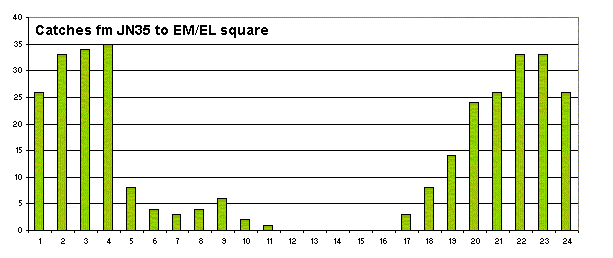
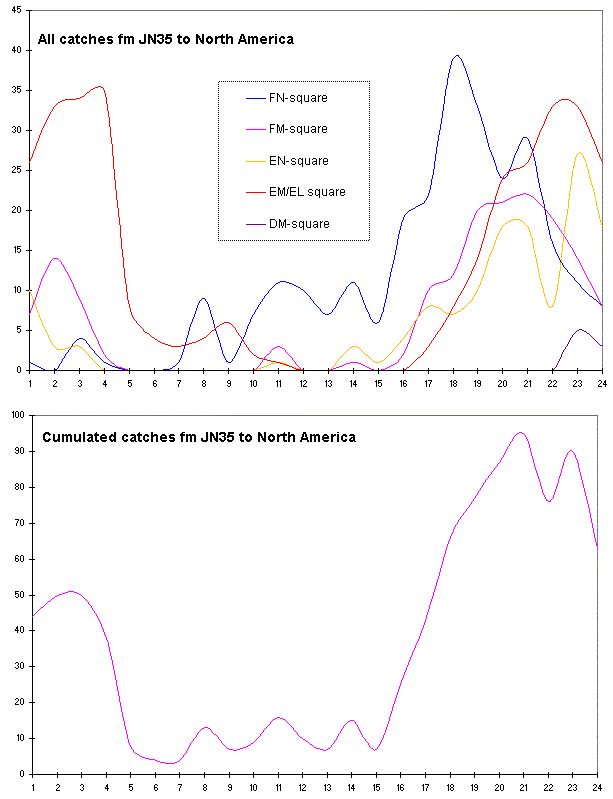
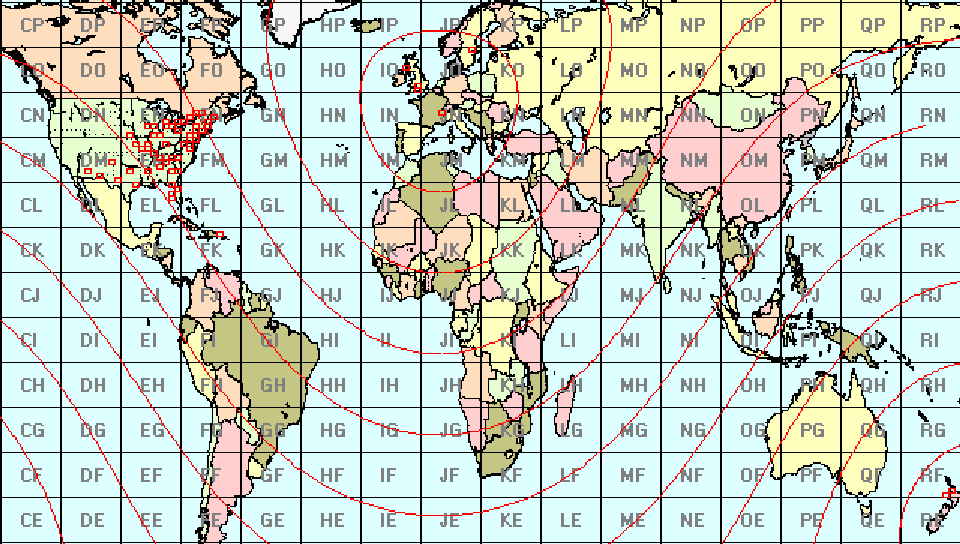
A full report on the 30m "play on PropNet" weekend is now available by following this link

Monday, October 08, 2007

Propnet 30m weekend

For once a non contest activity !
This weekend I participated to the propNet 30m weekend, a 30m propagation study. For more details on the propNet project, you may follow this link or this one

Here is a first summary of the weekend activity. More to follow...

Wednesday, October 03, 2007

Another vertical for 30, 40, 80 (and 160)

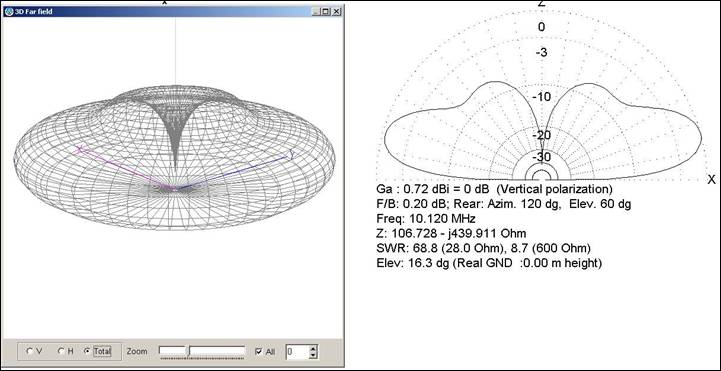
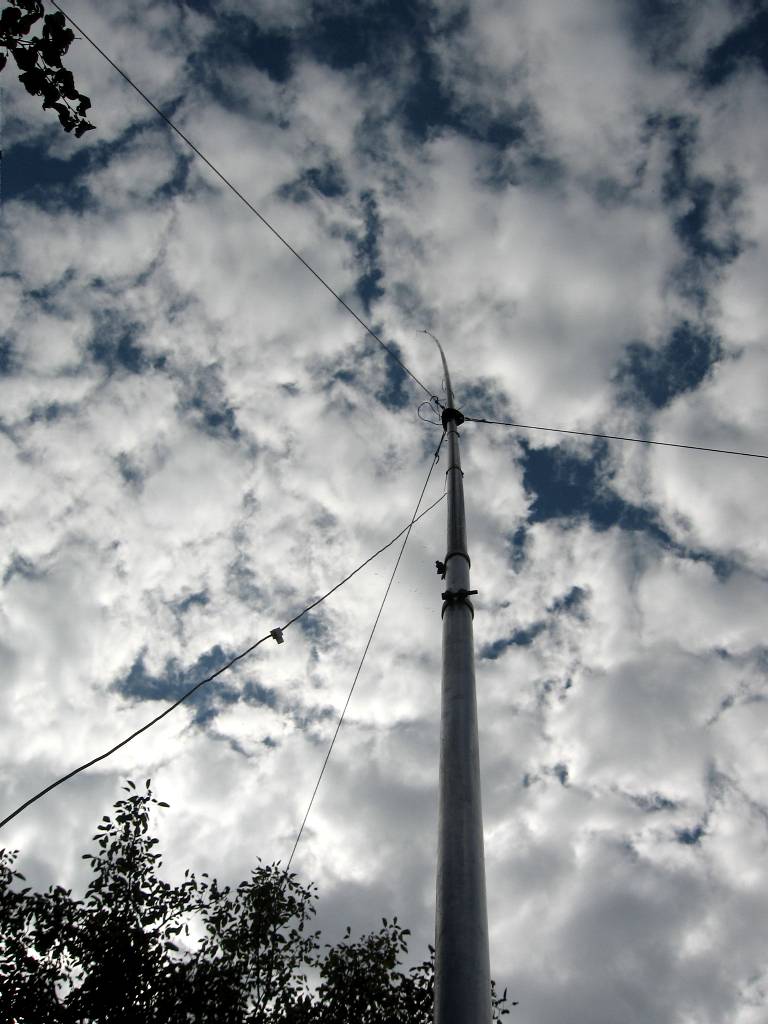
Following is a description of the multiband vertical antenna that I am using for several months.

Wednesday, September 26, 2007

Une verticale pour 30,40 et 80m

Ca faisait quelques temps que ce blog n 'avait pas été mis à jour ! Désolé...
Voici, pour me rattaper une description de l'antenne verticale bande basse que j'utilise depuis quelques mois.
Article en Français

Wednesday, March 28, 2007

Saturday, February 24, 2007

The CN2WW 80m wire-beam

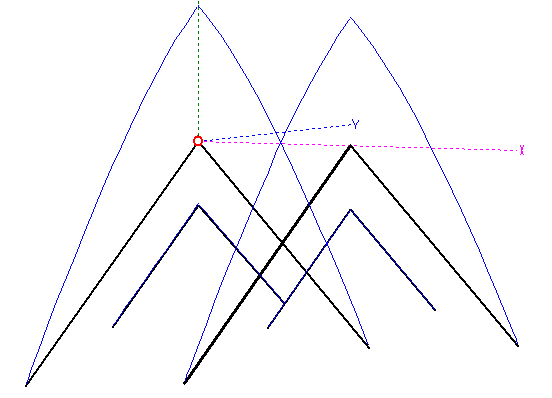
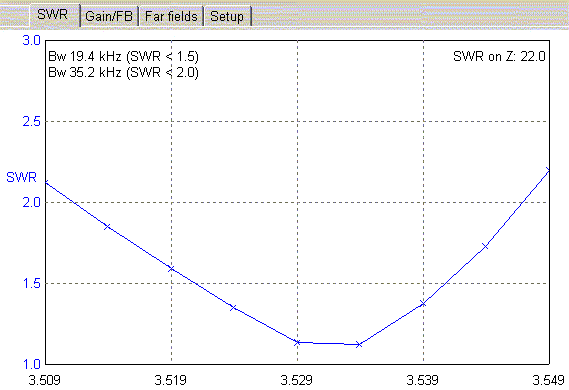
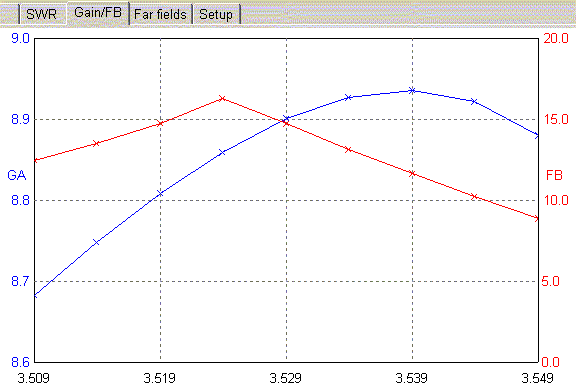
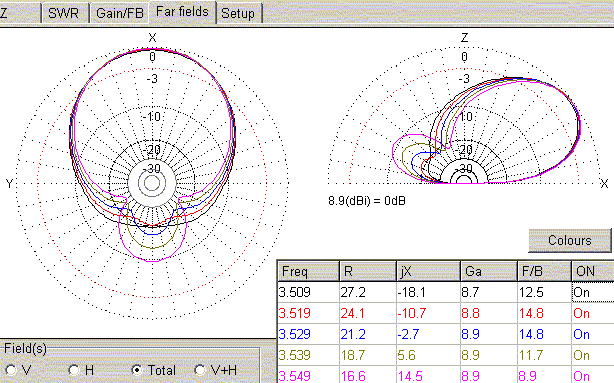
After testing the concept last year in the ARRL-DX from home (see http://f6irf.blogspot.com/2006/02/low-cost-2-elements-for-40m.html ) I designed a new antenna, especialy for the ARRL-DX from CN2WW. The terrasse dimensions, limiting us to 8m spacing, I used a director rather than the classical reflector. The drawing shows the 2 beams (40 and 80) using the same supports. Obviously with a such a reduced spacing (0.1 wl), the antenna cannot be designed for z=50 while giving satisfactory performances, but using a UNUN provides a perfect and broadband match, with very low losses (The steppIR uses the same type of broadband matching device). The multi-UNUN based on a W2FMI design and commercialized by CWSbytemark ( http://www.cwsbytemark.com/ ) offers an easy and flexible solution. A second unit allowed the 40 beam to be designed for max gain, with impedance around 36 ohms. The only difference is that the 40m UNUN was placed after a 1/2wl of cable, and not directly at the feed point ( the 40m dipole being on a fiber mast). The following graphs show the performances of the 80m aerial.


The bandwith was the main concern, but as shown by the graphs most of CW-contest band is usable with SWR below 2. Although I have full confidence in computer simulation, the results obtained with this aerial during the ARRL-DX really surprised me. see http://lists.contesting.com/archives//html/3830/2007-02/msg01551.html ). I believe that on top o f the 3.5dBd gain its main quality has been to protect us from the heavy EU-QRM.
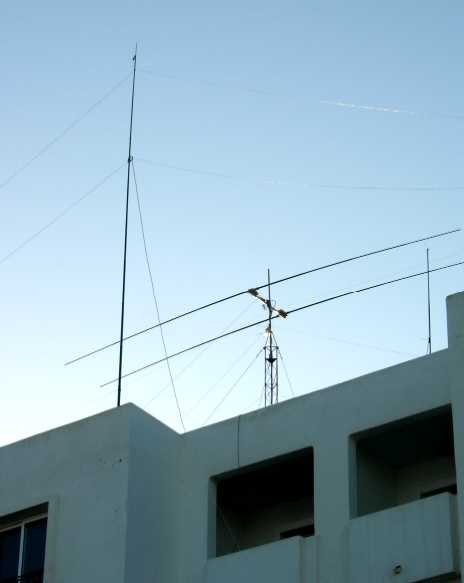
View of the aerials installed at CN2WW, the fiber mast supports the 40m dipole and the 80m director while the tower supports the 40m reflector and the 80m dipole.
As information the dimensions provided by the computer model are the following one: For 8m spacing and a center angle of 120 degrees, the half-dipole is 21.18m and the half-director 20.6m. But of course the dimension may vary, fonction of the height, the angle, the environment, the wire used (i.e. plastic coated wire has a velocity factor in the order of 0.95), so it is strongly recommended to adjust the dipole alone first below the desired frequency (removing the director on the computer model gives 3.465 for jX=0) Then place the director and cut it until the desired frequency is obtained (3.532 for jX=0 ). I think that it is the best way to get the aerial working as expected.
Computer models (MMANA or NEC2) can be provided on request.

Sunday, February 04, 2007

F6IRF 100,000 QSO's in 5years

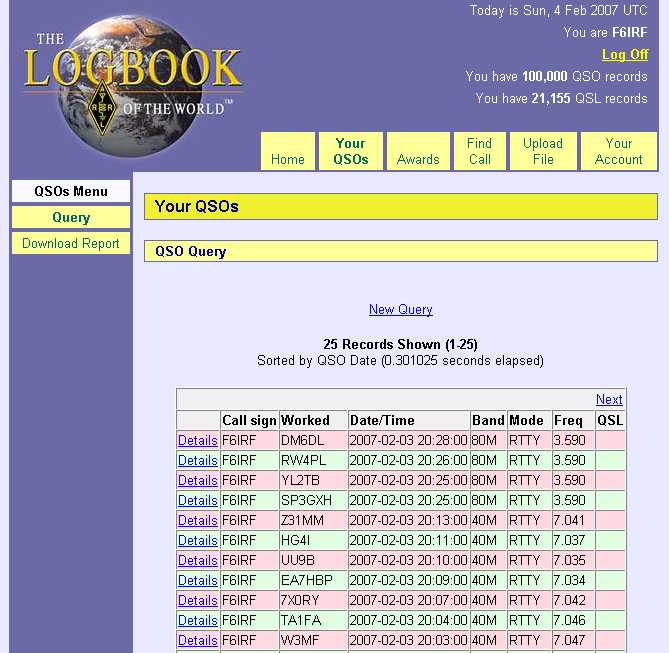
Today I have uploaded the 100,000 QSO, since march 2002 to LOTW. Those include QSO's done with F6IRF, F6IRF/P, TM6A, IS0/F6IRF, FG/F6IRF, UT/F6IRF/P and CN2WW callsigns.
DM6DL is the 100,000, and wins a CN2WW Tshirt :-)